"This is to suggest installing more help points in Sydney Central Station. Last week I was descending on an escalator from platform 21, when I saw someone fall backwards on the up escalator. They were being dragged up feet first, with arms flailing, as they attempted to get up. I was worried they may be injured, so ran down and pressed the emergency stop button. I looked around but could see no staff, nor an emergency help button. Two other members of the public (more spritely than me) ran up the escalator and helped the person to their feet. However, they were obviously injured, so I called Triple-0 on my phone and asked for an ambulance. As I was describing the injuries to the emergency operator, two station staff arrived, summoned by another bystander, who had finally found a help point. I handed my phone to the senior staff member, and after they talked to the ambulance center, returned it to me and I left the station." Sent to Transport for NSW, 19 April 2025
Apart from being unable to find any way to summon station staff, I had difficulty describing where I was, being underground away from streets. So I have now installed the Emergency+ app from the emergency services. This includes what3words, which uses 3 words to identify every 3 square meters of the planet.
Showing posts with label emergency management. Show all posts
Saturday, April 19, 2025
Monday, March 23, 2020
NSW Government COVID-19 Updates Page Could be Sped Up.
The content on the NSW Government COVID-19 Updates page is well set out, but the page could be implemented better technically. It scores only 57/100 on the Google Page Speed Insights tests. could be sped up. Here are the changes Google suggests. Detailed advice is provided on the website for each:
- Reduce the impact of third-party code Third-party code blocked the main thread for 330 ms
- Serve static assets with an efficient cache policy 9 resources found
- Minimize main-thread work 2.4 s
- Avoid chaining critical requests 24 chains found
- Keep request counts low and transfer sizes small 48 requests • 548 KB
Thursday, March 19, 2020
Video Conference on COVID-19 and the Rebewable Energy Business
Greetings from the Australian National University in Canberra, where I am taking part in a webinar (video conference) on "COVID-19 and the Household/Commercial Solar and Battery Storage Market", hosted by the Smart Energy Council. Interestingly there is a demand for batteries and solar in regional areas, perhaps due to a wish to be independent from the grid. However, demand is expected to reduce. The supply from China, the effects of the reduction in the value of the Australia dollar, and the government incentives were discussed. There was a reminder to look after staff health, and our own. This was an excellent example of how an industry association can keep their members informed. I suggest other industry bodies and professional societies follow this example.
There were only a few brief dropouts in the audio (fewer than on ABC Radio National this-morning). The talking heads video worked well and the presenters slides were very clear. One improvement would be to give a web link in the text chat with notes. As it was, the presenter suggested photographing the web address on a slide, which is cumbersome.
The video conferencing product being used was Zoom. This is not my favorite, as there is no way for participants to set the audio or video quality to reduce bandwidth. However, it is possible to reduce data use with a smaller video window.
During the presentation, with live video full screen, this was using about 1,000 kbps. If I reduced the size of the video window to 512 by 240 pixels, the data reduced to 300 kbps. Minimizing the video to a "thumbnail" (200 by 112 pixels) reduced data to 220 kbps. Hiding the video reduced data to 120 kbps. This is consistent with Zoom's documentation: 1.2 Mbps for HD video, screen sharing with video thumbnail at 50-150kbps, and screen sharing only with no video thumbnail 50-75kbps.
During a presentation such as this, video is really only needed at the start to introduction the speaker, and at the end during questions, if at all. In between there are usually slides to look at, so the video can be minimized, or hidden. I suggest participant adopt that way of viewing, and if possible, event organizers set this up as the default.
Zoom, and other video products, adjust to the bandwidth available, but then tries to use all that bandwidth. This makes them poor online citizens, like someone who fills their trolley with toilet paper, if you let them.
As there is likely to be a high demand for Internet access over the next few months, I suggest that providers of video conference products set defaults to use less bandwidth. At the very least they could be set so only a small video window appears by default. Also they could provide a low speed option which uses no more than 256 kbps, and this could be made the default setting. As an example, Zoom has a maximum bandwidth setting, but this is disabled by default. This should be enabled and set to no more than 256 kbps.
There were only a few brief dropouts in the audio (fewer than on ABC Radio National this-morning). The talking heads video worked well and the presenters slides were very clear. One improvement would be to give a web link in the text chat with notes. As it was, the presenter suggested photographing the web address on a slide, which is cumbersome.
The video conferencing product being used was Zoom. This is not my favorite, as there is no way for participants to set the audio or video quality to reduce bandwidth. However, it is possible to reduce data use with a smaller video window.
During the presentation, with live video full screen, this was using about 1,000 kbps. If I reduced the size of the video window to 512 by 240 pixels, the data reduced to 300 kbps. Minimizing the video to a "thumbnail" (200 by 112 pixels) reduced data to 220 kbps. Hiding the video reduced data to 120 kbps. This is consistent with Zoom's documentation: 1.2 Mbps for HD video, screen sharing with video thumbnail at 50-150kbps, and screen sharing only with no video thumbnail 50-75kbps.
During a presentation such as this, video is really only needed at the start to introduction the speaker, and at the end during questions, if at all. In between there are usually slides to look at, so the video can be minimized, or hidden. I suggest participant adopt that way of viewing, and if possible, event organizers set this up as the default.
Zoom, and other video products, adjust to the bandwidth available, but then tries to use all that bandwidth. This makes them poor online citizens, like someone who fills their trolley with toilet paper, if you let them.
As there is likely to be a high demand for Internet access over the next few months, I suggest that providers of video conference products set defaults to use less bandwidth. At the very least they could be set so only a small video window appears by default. Also they could provide a low speed option which uses no more than 256 kbps, and this could be made the default setting. As an example, Zoom has a maximum bandwidth setting, but this is disabled by default. This should be enabled and set to no more than 256 kbps.
Tuesday, March 17, 2020
NSW Health Coronavirus Web Page Slow and Unreliable Due to Flawed Design
![]() |
| NSW Health Coronavirus Page (mobile version) |
A Google Page Speed check on the mobile version page rated it 18/100, which is a very poor result. The tool pointed out the page could be improved with some simple changes, such as using a more efficient format for images and changing the way style sheets (CSS) are used.
In 2005 I supervised a student project at ANU on how to design credible emergency websites. From this a set of Emergency Management Website Assessment Criteria was produced. There is also a detailed report.
If you are providing emergency information online, please make your web pages small, simple, and clear.=
Sunday, March 15, 2020
How Tech Can Help with the COVID19 Pandemic
The most useful things we can do to help with the COVID19 pandemic are not very high tech, or glamorous. The things which are high tech take years to design and implement, so I suggest helping implement those which have already been developed, and not building new ones. This advice is based on twenty years helping out with tech for emergencies.
Some things we can do:
In 2005 I supervised a student project at ANU on how to design credible emergency websites. From this a set of Emergency Management Website Assessment Criteria was produced. There is also a detailed report.
Also we can assist with tools, services, and support, to help people work, study, and be entertained on-line. Networks and servers may be more heavily loaded than usual. We can implement ways to reduce the load, by configuring systems to use less data and processing, and giving users tips on using them efficiently. As an example, the bandwidth used by video conferencing can be reduced by avoiding using high resolution video (or by avoiding the use of video at all). Web pages can have images with reduced resolution, and optimized code.
Sahana was developed by the Sri Lanka tech industry in response to the 2004 Indian Ocean tsunami. The software was then used around the world for other emergencies. But it takes time to have such software accepted. One thing done with Sahana was to set up a US registered foundation, not only to get funding, but more importantly, credibility.
Some things we can do:
USE THE INTERNET TO PROVIDE INFORMATION AND COUNTER MISINFORMATION
We can help educate the community on what to do, and counter misinformation.In 2005 I supervised a student project at ANU on how to design credible emergency websites. From this a set of Emergency Management Website Assessment Criteria was produced. There is also a detailed report.
SUPPORT EXISTING TOOLS
Also we can assist with tools, services, and support, to help people work, study, and be entertained on-line. Networks and servers may be more heavily loaded than usual. We can implement ways to reduce the load, by configuring systems to use less data and processing, and giving users tips on using them efficiently. As an example, the bandwidth used by video conferencing can be reduced by avoiding using high resolution video (or by avoiding the use of video at all). Web pages can have images with reduced resolution, and optimized code.
SUPPORT EXISTING SPECIALIZED EMERGENCY TOOLS
There are more specialized tech tools for supporting large scale emergencies, such as the Sahana Open Source Disaster Management Software. In 2013 I talked at a Meetup in Colombo to discuss using Sahana for mapping a pandemic.Sahana was developed by the Sri Lanka tech industry in response to the 2004 Indian Ocean tsunami. The software was then used around the world for other emergencies. But it takes time to have such software accepted. One thing done with Sahana was to set up a US registered foundation, not only to get funding, but more importantly, credibility.
Wednesday, January 24, 2018
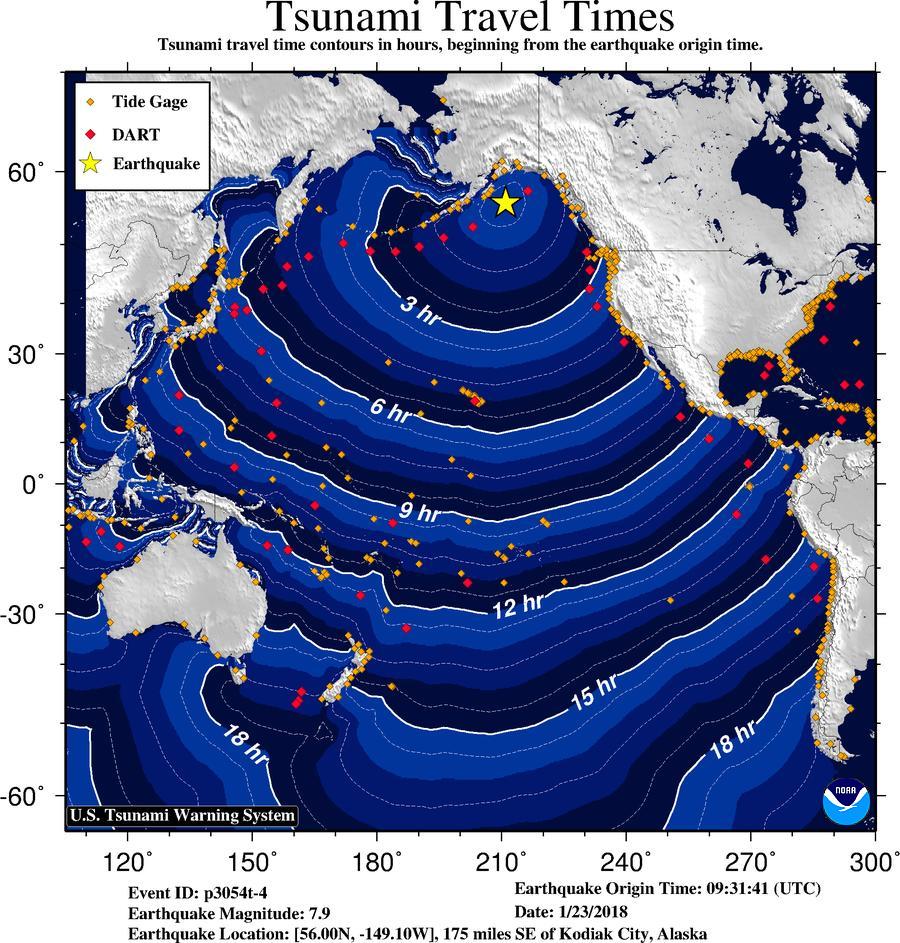
U.S. Tsunami Warning System Problem
![]() |
| Tsunami Warning after an earthquake near Alaska at 01-23-2018 09:35:57 UTC |
However, when I checked the home page at 11:15 UTC the map did not show the earthquake location and instead said "Earthquake Layer failed to load" and "Alerts/Threats Layer failed to load". This would appear to be because the system was overloaded. I then canceled the page request, not wishing to make the situation worse.
The NWS Tsunami Alerts Twitter feed was working at the time. However, the twitter alerts contained a link to the same non-functioning web page:
NWS Tsunami AlertsThere were some maps provided direct in the twitter feed, which did display:
Verified account @NWS_NTWC
2m2 minutes ago
TSUNAMI WARNING 4: See http://tsunami.gov for alert areas.
M7.9 175mi SE Kodiak City, Alaska 0032AKST Jan 23:
![]() |
| Tsunami Travel Time Map, from U.S. Tsunami Warning System |
MediaHowever, these maps are difficult to interpret, as they showed a series of predicted arrival times as colored lines, with no scale as to the size of the wave. The waves were shown reaching Australia in 11 hours, although no warning had been issued by the Joint Australian Tsunami Warning Centre.
NWS Tsunami Alerts
Verified account @NWS_NTWC
1m1 minute ago
Tue Jan 23 11:18:49 UTC 2018 event picture
https://pbs.twimg.com/media/DUOMO-xWsAAOEMk.jpg
Colored dots on the map indicated the location of tidal gauges and "DART". Not explained on the map, DART is a system of "Deep-ocean Assessment and Reporting of Tsunamis" detectors.
Fortunately in this case the tsunami was only 6 inches high (as reported at Old Harbor Alaska 0256 PST Jan 23). However, I suggest revising the design to use simple static map images on the web site, using a few colors, so the file is small. Also the use of extensive JavaScript should be avoided to allow the page to load quickly. At present the HTML file is only 61 kBytes, but the other files are 3.4 Mbytes, including a 1.2 Mbyte JavaScript file.
The tidal gauge and DART locations are not of use to someone who wants to know when, when and how large a tsunami to expect. These should be omitted from the map, unless they show a reading. The predicted arrival time should be limited to a few hours, until the existence of a significantly sized tsunami is confirmed.
Thursday, October 13, 2016
Australian Cybersecurity for Energy
Greetings from the National Gallery of Australia where Michelle Price, Department of Prime Minister & Cabinet (currently at the ANU National Security College) is speaking on "Cyber security in relation to Australia’s energy security". This is part of an Energy Security Forum.
Dr. Price suggested talking about "critical services", rather than critical infrastructure. This is to focus on what people need, rather than poles and wires. For the first week of a disaster she suggested the Internet and electricity are all that are needed. I found this surprising, as I had assumed the HF radio systems Australian governments maintain would be sufficient for essential services. In 2015 the Australian Defence Force tested transmitting digital video via an Internet Protocol (IP) data link over Wideband High Frequency (WBHF) radio between Canberra, Townsville, Wagga, and an aircraft on the ground in South Australia.
Friday, April 29, 2016
NBN Emergeny Management
Greetings from the University of Sydney's business campus in the CBD, where Cameron Scott, NBN Network Emergency Lead, is speaking on "NBN: Operation, Impact and Response". This is at a meeting of the Interoperability for Extreme Events Research Group (IEERG). NBN use a similar approach to emergency management as other telecommunication companies and liaises with emergency services. They have to be prepared for loss of part of their infrastructure and also be ready aid with response and recovery.
Mr. Scott pointed out that the NBN is used for telephony as well as Internet. Unlike the Plain Old Telephone Service (POTS) the NBN telephony service requires mains power at the consumer's premises. Some NBN equipment has provision of limited battery backup.
NBN is building some transportable equipment to use where there is a loss of infrastructure:
NBN will also have transportable satellite ground stations, for ad-hoc use.
After a disaster, NBN will prioritize restoration of essential services, community infrastructure and essential businesses services.
Customers need to register as a "Public Interest Premises" to receive priority recovery service.
An interesting aspect of this, which I suggest needs research, is how the customers reliance on the Internet has changed how they will respond in an emergency. In particular, if the public is used to using the Internet for information, replacing radio, TV and the telephone, how will they cope when the Internet is not available? One option might be to provide car USB chargers or battery radios to the public. Otherwise communications will be reduced to loudspeaker vans in the street.
Mr. Scott pointed out that the NBN is used for telephony as well as Internet. Unlike the Plain Old Telephone Service (POTS) the NBN telephony service requires mains power at the consumer's premises. Some NBN equipment has provision of limited battery backup.
NBN is building some transportable equipment to use where there is a loss of infrastructure:
- NoW: Network on Wheels for remediation of a fibre access node,
- WoW:Wireless on Wheels: Replacement fxed wireless tower.
- PoW: Point of Internet Connect on Wheels
NBN will also have transportable satellite ground stations, for ad-hoc use.
After a disaster, NBN will prioritize restoration of essential services, community infrastructure and essential businesses services.
Customers need to register as a "Public Interest Premises" to receive priority recovery service.
An interesting aspect of this, which I suggest needs research, is how the customers reliance on the Internet has changed how they will respond in an emergency. In particular, if the public is used to using the Internet for information, replacing radio, TV and the telephone, how will they cope when the Internet is not available? One option might be to provide car USB chargers or battery radios to the public. Otherwise communications will be reduced to loudspeaker vans in the street.
Monday, January 18, 2016
Review of Australian Fire Alert System
In "Analysis: Fire alert system overhaul could boost awareness" Andrew O'Connor\ (ABC, 16 January 2016), wrote that current Australian bushfire alerts "... make the task of quickly building accurate situational awareness difficult and vulnerable to misperception and misunderstanding". There is a very large body of research on communication of emergency public warnings (with about 7,000 papers in 2015). The advent of the Internet and the web has aided this, not only by providing another method of communicating warnings, but providing a new avenue for understanding how people understand messages.
Friday, March 27, 2015
Analyzing Tweets to Asses Jakarta Flooding
Greetings from the University of Sydney Business New Approaches and Technologies for Community Resilience and Disaster Recovery". The most interesting presentaion so far is by
Rodney Clarke (UoW) onusing Tweets to monitor flooding in Jakarta with PetaJakarta.org. Faculty in the Sydney CBD, where I am attending a symposium on "
Tuesday, February 24, 2015
Survival Tool and PIB Better Than Emergency App
David Frith provides a compelling first hand report of being rescued with the help of Australia's new Emergency Plus app (see "Emergency app that could save your life one day", The Australian, February 24, 2015
12:00AM). But this app depends on having a functioning smart phone and being in range of the mobile network. If you are going beyond the mobile network or in conditions where a consumer smart phone will break, then you need something better.
As David points out small Personal Locator Beacons
(PLBs) are available for about $400. These are robust and waterproof. They transmit a signal to a special network of satellites (not the GPS satellites as David suggests). The PLB's location is estimated by the satellites to within a few km and the rescue services notified (if equipped with GPS the PLBs give a more accurate fix). To activate the unit you simply flip up the antenna and press a button.
If hiking alone, there are also Satellite Communicators
, which will send a regular position signal. This way if you are overdue, your friends can report your last know location to the rescue services. These units use a separate satellite network and require payment of a subscription (whereas PIBs require no subscription). These units also have a SOS button, but can't be expected to provide as reliable a service as PIBs.
A useful gadget I purchased recently is a keyring multitool
. This is one piece of stainless steel about the size of a key, which has slots and knobs on it to act as a screwdriver, spanner and bottle-opener. More relevant for an emergency is the slot for cutting cord and webbing (such as seat-belts and backpack straps). The tool does not have an exposed blade, so it is safer to carry in your pocket and use under extreme conditions.

ps: If he is going to make a habit of falling into deep water while wearing a backpack, then David might want to invest in a Automatic Inflatable Life Jacket
and water activated distress beacon. ;-)
ps: If he is going to make a habit of falling into deep water while wearing a backpack, then David might want to invest in a Automatic Inflatable Life Jacket
Sunday, November 30, 2014
Hacked for Humanity in Sydney This Weekend
First Stop are building a system for registering survivors after a disaster, so they do not need providing the same details to every agency. This is intended to not add to an already stressful situation and allow more time for helping the survivors. Already First Stop had a barcode printing application using vcard, from a previous RHOK (used for participants at this RHoK). This weekend the team added the capability of adding extra data fields to suit different agencies.
OCIUS: Are providing a website for analysis of data from a BlueBottle USV
. This is a uncrewed solar and wind powered vessel which collects oceanographic data. The problem is explaining to potential users and the general public what the USV can provide and how it can be used. The team looked at needs of the media, environmental groups and researchers. The aim is to demonstrate the system sailing autonomously around Lord Howe Island, transmitting data via SkyWave . I suggested activities for children be built into the website, such as where they carry out calculations from the data and identify and count animals seen by the on-board camera. This reminds me of the Australian developed Aerosonde Robotic Aircraft. which was the first to cross the North Atlantic Ocean
(3,200 kilometres in 26 hours). While the system is intended for environmental monitoring, it also has obvious military applications. The Australian shipbuilding industry could do with a boost, having come in for criticism from the Minister for Defence, who said he did not trust the government owned shipbuilder"build a canoe".
First Robotics: This is an Australian offshoot of the US First STEM Project, to interest children in science, technology, engineering and mathematics (STEM). First Robotics provide activities for Australian school children using robots (including Lego robot kits). The RHoK exercise this weekend was to look at how to market the activities to parents and teachers. The team produced style guides, wire-frames and surveys for the website.
Benjam: Is a project for the " Woodbury Autism Education and Research" to build an App which al lows children with autism to communicate with their carers. This would use off-the-shelf networked mobile devices and have a user expandable vocabulary. An example given was a new type of biscuit . The team presented a series of use case diagrams, showing the user journey. The concept is that the device would respond to gestures , such as nodding and pointing. While there has been considerable Human Computer Interface (HCI) research on gesture interfaces and some real products (mostly games) these are too compl ex for this use. Suc h an interface might be of use for adults where their attention is limited, such as when driving . Also Australia has an Autism Cooperative Research Centre, which may find this project of interest.
I was one of the three judges and we were unanimous in awarding Benjam a trophy , but all the projects were good.
ps: From 19 January 2015 teaching a "New Technology Alignment" (NTA) on-line course at the ACS Virtual College (register now ).
OCIUS: Are providing a website for analysis of data from a BlueBottle USV
First Robotics: This is an Australian offshoot of the US First STEM Project, to interest children in science, technology, engineering and mathematics (STEM). First Robotics provide activities for Australian school children using robots (including Lego robot kits). The RHoK exercise this weekend was to look at how to market the activities to parents and teachers. The team produced style guides, wire-frames and surveys for the website.
Benjam: Is a project for the " Woodbury Autism Education and Research" to build an App which al lows children with autism to communicate with their carers. This would use off-the-shelf networked mobile devices and have a user expandable vocabulary. An example given was a new type of biscuit . The team presented a series of use case diagrams, showing the user journey. The concept is that the device would respond to gestures , such as nodding and pointing. While there has been considerable Human Computer Interface (HCI) research on gesture interfaces and some real products (mostly games) these are too compl ex for this use. Suc h an interface might be of use for adults where their attention is limited, such as when driving . Also Australia has an Autism Cooperative Research Centre, which may find this project of interest.
I was one of the three judges and we were unanimous in awarding Benjam a trophy , but all the projects were good.
Venue
The Commonwealth Bank building in Sydney provided an excellent venue. RHoK u sed a meeting room with a n outdoor area with views o ver Darling Harbor . The building has an atrium letting light down into all levels of the building and an open plan layou t, with no walls at all onto the atrium.ps: From 19 January 2015 teaching a "New Technology Alignment" (NTA) on-line course at the ACS Virtual College (register now ).
Saturday, November 29, 2014
Hacking for Humanity in Sydney This Weekend
Greeting from the Commonwealth Bank headquarters at Darling Harbor in Sydney, where Random Hacks of Kindness Sydney (RHoK) is holding their RHoK November Hackathon. About thirty people have volunteered their time to work on computer applications with a social purpose. The weekend starts with presentations by those with an idea, or problem, teams then select an application to work on work on. On Sunday afternoon the teams present what they have produced. There is a trophy for the best implementation, but as the organizers emphasize, this is about participating, not winning. I am one of the judges and this should be good experience for when I am teaching New Technology Alignment in January.
One of the problems t work on is analysis of data from the BlueBottle USV. This is a uncrewed solar and wind powered vessel which collects oceanographic data. The problem is the analysis of the large amounts of data the drones collect.
A second problem owner is "Woodbury Autism Education and Research". They would like an App which allows children with autism to communicate with their carers.
One of the problems t work on is analysis of data from the BlueBottle USV. This is a uncrewed solar and wind powered vessel which collects oceanographic data. The problem is the analysis of the large amounts of data the drones collect.
A second problem owner is "Woodbury Autism Education and Research". They would like an App which allows children with autism to communicate with their carers.
Friday, October 24, 2014
Paper Bushfire Plans Putting Lives at Risk
ABC has provided the useful video "What would you do if a bushfire threatened your home?", but the accompanying text points out a flaw in Australian emergency planning. In "Facing a disaster: the brain makes it harder than you expect", it says the video "... demonstrates the need for a plan that is written down ...", but then "It demonstrated in graphic fashion the difficulties people have ...". The key word here is graphic: the video with images is a more effective form of communication than writing.
The Bushfire Survival Plan from the ACT Emergency Services Agency is a 24 page document which is designed to be read on paper. While it is available as a PDF download, the document contains pages which are in landscape mode and appear sideways on screen. This document is hard enough to read on a desktop computer screen, let along a smart-phone. The document includes a photo of a family sitting around a table with one member diligently filling out the paper form in the printed booklet. This is far from the reality of how a 21st Century family interacts, as such a family would typically have several smart-phones and tablet computers at the table, with no paper.
People have difficulty reading large amounts of text, particularly when stressed. For this reason emergency exit sings in buildings no longer have the word "EXIT" but instead a pictogram of a running man. I suggest taking the same approach to emergency plans. There should be the option of completing the emergency plan via a web page and app, with more graphics and less text. All the members of the family should then be able to access the plan on their smart phone or Internet account.
Communicating this information can take advantage of the expertise available from on-line adult education, where busy distracted people are helped through the process of learning. One way top do this is to advise the student what they are going to learn and what they will have to do up front. ACT emergency booklet does not do this, taking until page 16, more than half way through, to get to the actual form. Most householders are unlikely to ever read to this point. I suggest this could be "flipped" and the householder being told they task they have and then the materials in support of that task.
Friday, September 19, 2014
Interoperability for Extreme Events
Greetings from the University of Sydney, where I am taking part in a Symposium on "Resilient Disaster Systems: Improving Service Delivery to Disaster Areas". This is being hosted by USyd's Interoperability for Extreme Events Research Group (IEERG). My talk is late in the day on "Sahana: a practical information solution path for international disaster management". Michael Howden, CEO of the Sahana Software Foundation
provided materials for my presentation, and he will be visiting Sydney in late November 2014. Professor Deborah Bunker heads the IEERG is also running a symposium in the UK in October.
The first presentation for the day is discussing some of the systems used for a recent explosion in the Sydney suburb of Roselle. The second presentation mentioned that there is an Inquiry into the Natural Disaster Relief and Recovery Arrangements (NDRRA), which allocates recovery for recovery between federal and states. One problem mentioned which has come up recently was asbestos risk after a fire.
One interesting comment in one presentation was about making communities more resilient. Helping people meet their neighbours, so in a disaster they will know who can help, would be useful.
Statistics on where people got their information in recent bushfire showed that the official website is used mostly, followed by local radio. Social media was used by only a few percent of people. This raises a resourcing issue for emergency organisations: they may be better off spending more money on their website and connections to the media, even though this is not a seen as glamorous as use of social media.
One issue which came up was how to make official online communications look credible. In 2004 I had a student prepare criteria for making an emergency web page look credible. See: "Evaluating Emergency Management Websites".
Late in the day the topic of terminology came up. Someone from the Red Cross commented they got invited to speak at IT events on "Emergency Management", but that has a whole different meaning in the IT field. I looked up the SFIA Skills and found that the closest term in the IT area was "Availability management".
Much of the discussion today assumes that Internet access, mostly via mobile networks, is available in an emergency. A parliamentary Inquiry looked at a “Priority over-ride service", so emergency service workers could use the mobile service in an emergency. As far as I can see no action was taken on this. Rather than have some sort of manually prepared master list of key personnel's phone numbers, it would seem to me simpler to have all mobile phones issued to government employees and those from service companies (energy, telecommunications, medical services and supply companies).
The first presentation for the day is discussing some of the systems used for a recent explosion in the Sydney suburb of Roselle. The second presentation mentioned that there is an Inquiry into the Natural Disaster Relief and Recovery Arrangements (NDRRA), which allocates recovery for recovery between federal and states. One problem mentioned which has come up recently was asbestos risk after a fire.
One interesting comment in one presentation was about making communities more resilient. Helping people meet their neighbours, so in a disaster they will know who can help, would be useful.
Statistics on where people got their information in recent bushfire showed that the official website is used mostly, followed by local radio. Social media was used by only a few percent of people. This raises a resourcing issue for emergency organisations: they may be better off spending more money on their website and connections to the media, even though this is not a seen as glamorous as use of social media.
One issue which came up was how to make official online communications look credible. In 2004 I had a student prepare criteria for making an emergency web page look credible. See: "Evaluating Emergency Management Websites".
Late in the day the topic of terminology came up. Someone from the Red Cross commented they got invited to speak at IT events on "Emergency Management", but that has a whole different meaning in the IT field. I looked up the SFIA Skills and found that the closest term in the IT area was "Availability management".
Much of the discussion today assumes that Internet access, mostly via mobile networks, is available in an emergency. A parliamentary Inquiry looked at a “Priority over-ride service", so emergency service workers could use the mobile service in an emergency. As far as I can see no action was taken on this. Rather than have some sort of manually prepared master list of key personnel's phone numbers, it would seem to me simpler to have all mobile phones issued to government employees and those from service companies (energy, telecommunications, medical services and supply companies).
Friday, November 22, 2013
Fund for Humanitirian Software to Support Disaster Response
The Sahana Software Foundation has launched a Philippines Appeal. The foundation provides free open source disaster response software and training. The software is used by government and non-government organizations around the world to coordinate relief operations after natural disasters. The software is in use by the Philippine Department of Social Welfare and Development and the Philippines Red Cross for Typhoon Haiyan recovery operations.
The Sahana Software Foundation is non-profit organization registered in the State of California, USA. In 2010 it received the PPBI Best Practices Award for its work on Haiti Earthquake and in 2013 was named Computerworld Honors Laureate for information technology to benefit society.
Thursday, October 24, 2013
Ten Years of Post-Tsunami Recovery in Sri Lanka
A call for papers has been issued for the 2nd Asian Conference on Information Systems for Crisis Response and Management on the topic "10 Years of Post-Tsunami Recovery: the role of ICTs in building disaster resilience". The conference ISCRAM-Asia 2014, will be Colombo, to be held in Sri Lanka, 20-21 June 2014.
2nd Asian Conference on Information Systems for Crisis Response and Management
Call for Papers
CONFERENCE THEME: 10 years of post-tsunami recovery: the role of ICTs in building disaster resilience
ISCRAM-ASIA 2014: 2nd Asia-Continental Conference on Information Systems for Crisis Response and Management
CONFERENCE DATES: Friday 20th & Saturday 21st June 2014 LOCATION: Colombo, Sri Lanka.
THEMES
1. RESPONSE
1.1 Coordination, Search and rescue / First Aid
1.2 Humanitarian and Disaster relief supply chain management
1.3 Emergency management information systems (Information Systems supporting Situational Awareness, disaster relief supply chain management)
2. REHABILITATION AND RECONSTRUCTION
2.1 Humanitarian challenges
2.2 Reconstruction, long term recovery and ecosystem reconstruction
2.3 Resettlement (land use planning/reasoning)
2.4 Monitoring long-term progress in disaster risk reduction
3. CROSS CUTTING ISSUES
3.1 ICTs for Disaster Risk Management
3.2 Decision support systems
3.3 Risk communication, dissemination and comprehension
3.4 Development and operationalization of response control systems
3.5 Intelligent systems
3.6 Use of ICTs in public health and emergency medical management
3.7 Role of social media in risk perception, awareness, knowledge management, and crisis response
3.8 Mobile technology for real-time emergency response
4. PREPAREDNESS
4.1 The role of cultural and gender dimensions in disaster vulnerability, response, and recovery
4.2 Innovative Multi-stakeholder Community-focused Partnerships in DRR and EWS
4.3 Functional Early Warning Systems
4.4 Disaster Risk Assessment
4.5 Emergency drills and simulations
5. PREVENTION AND MITIGATION
5.1 Risk communication, dissemination and comprehension
5.2 Disaster risk insurance, management and planning
5.3 Development and operationalization of response control systems
5.4 Disaster awareness education training (or disaster education and learning)
5.5 Progress in developing early warning systems
5.6 Climate Change Adaptation
CONTRIBUTIONS
ISCRAM-ASIA 2014 invites two categories of papers. All paper submissions must be relevant to ISCRAM, make a new and significant contribution to the body of knowledge on information systems for emergency management, support their contribution with valid arguments, and be clearly structured and well written.
- Research papers presenting valid, original, relevant cutting edge research that will be reviewed to the highest academic standards. Reviewing will pay additional attention to the application of the related scientific literature and theory, to the use of an appropriate research methodology, and to technical, mathematical and statistical correctness. This will be complemented by a review from a member of the Scientific Committee (SC).
- Insights from the Practice of Emergency Management papers presenting new developments in emergency management and policy making, discussing approaches, methods, tools, (best) practices and standards. These papers should focus on practical issues and concerns and raise challenges for future research, and will be reviewed to the highest practice-oriented standards.According to the completeness of work, authors can choose to submit their work as
Posters
- Full papers presenting completed work. Such papers should be no more than 10pages including figures & tables (~5000 words).
- Short papers presenting work in progress and novel approaches that are beingdeveloped. Such papers should be no more than 4 pages with figures & tables (~2000 words).
- Posters presenting work in progress, novel approaches being developed or completed work must first outline the content of the poster through a 1 page abstract (~250 words), then followed by an image of the actual poster.
- Panel discussions presenting work in progress, novel approaches being developed or completed work must first outline the title, theme, context, and panelists credentials in a short-paper no more than 4 pages with figures & tables (~2000 words)For each type of paper, submissions are welcome from academics, researchers, practitioners, technical or other experts, policy makers, or other professionals in the emergency management domain. The proceedings will identify the type of submission and reviewing process chosen.Other forms of contributions: Separate calls are or will be made for workshops, panels, posters, demonstrations, and the doctoral consortium. All calls will be published on iscram2014.org.
TO SUBMIT A PAPER:
- Authors must submit papers electronically through the conference system. The link to the submission system will be available on the website in November.)
- All papers must use the ISCRAM paper template and follow the ISCRAM house style. The template will be available through the conference system and on the conference submissions page
Important Dates
Announce call for full-paper abstracts
20 October 2013
Deadline for submission of full-paper abstracts
24 November 2013
Review abstract and invite submission of full-papers
15 December 2013
Deadline for submission of full papers
09 March 2014
Deadline for panel proposals
09 March 2014
Deadline for short-paper submissions (work-in- progress & concept papers, poster proposals)
09 March 2014
Complete review of full-papers, short-papers, and
13 April 2014
panel proposals
FINAL submission of camera-ready full-papers, short- papers, and panel proposals
18 May 2014
FINAL decision made by the Program and Scientific Committee
01 June 2014
...
Wednesday, September 11, 2013
Disasters Conference in Canberra 18 September
The Australian National University will be hosting an international conference on "The Demography of Disasters: Implications for future policy on development and resilience", in Canberra, 18 - 20 September 2013.
As natural disasters impact inequitably on vulnerable populations around the world, disaster preparedness, recovery and reconstruction is increasingly being approached through the lens of integrated public policies on development, demographics, and disaster risk reduction. How the cross-cultural context influences disaster risk governance, and how new communities and families arise from the destruction will form the core dialogue for the papers from renowned international experts being presented at this conference.
Conference aims
Speakers
Major speakers will include:
- Professor Elizabeth Frankenberg, Duke University, North Carolina
- Professor Susan Cutter, University of South Carolina
- Professor Mark Pelling, King's College, London
- Professor Douglas Paton, University of Tasmania
- Professor Josifina Natividad, University of The Philippines
- Professor Yang Chenggang, Population Research Institute, Chengdu, China
- Professor Ken Miichi, Iwate Prefectural University, Japan.
Program, abstracts & biographies
Program (PDF 680KB)
Abstracts of papers (PDF 195KB)
Speaker biographies (PDF 52KB)
Registration
Thursday, August 01, 2013
Red Cross Removed from Medicare App
I noticed today that the red cross has been removed from the icon. There are other symbols which are commonly used to indicate medical services. The obvious solution in this case would have been to change the color of the cross. But removing the cross completely is an acceptable alternative.
Monday, July 29, 2013
Unlawful Use of Red Cross Symbol by Express Plus Medicare App
Subscribe to:
Posts (Atom)